No Witness
The chapter above in the details it kept — three shirts, one pair, that was the options, a name on the door swapped out like settings, and the hip that got metal when the bone couldn't hold weight.
Christopher grew up through a difficult childhood and foster care. Part of what made it difficult has a name: a hip disease that was destroying the joint while nobody knew.
During the last period he lived with his biological mother and stepfather, Christopher developed severe Legg-Calvé-Perthes disease — a childhood condition in which the blood supply to the hip fails and the joint starts to break down. It kept progressing through the moves that followed, into and through foster care.
He hid the pain. Not once, as a secret — as a habit. A child moving through family disruption had learned not to reveal what hurt, so he kept walking, kept going to school, and kept the severity to himself while the damage compounded. Through every placement and every transition, the condition went unrecognized.
Then he arrived at what he calls his forever home. His adoptive mother noticed almost immediately that something was seriously wrong — and acted immediately. He was medically evaluated at once, and about a week later, at about age 12, he underwent emergency reconstructive hip surgery. She didn't cure the disease; the damage was already advanced. What she changed was simpler and larger: the pain was finally seen, believed, and answered.
The childhood operation managed the damage. It never erased it. At 23, the joint had to be replaced entirely — a total hip replacement at an age when most people haven't thought about their hips once. The disease that began in a house he had to leave ended in hardware he still carries. That is the body under everything else on this site.
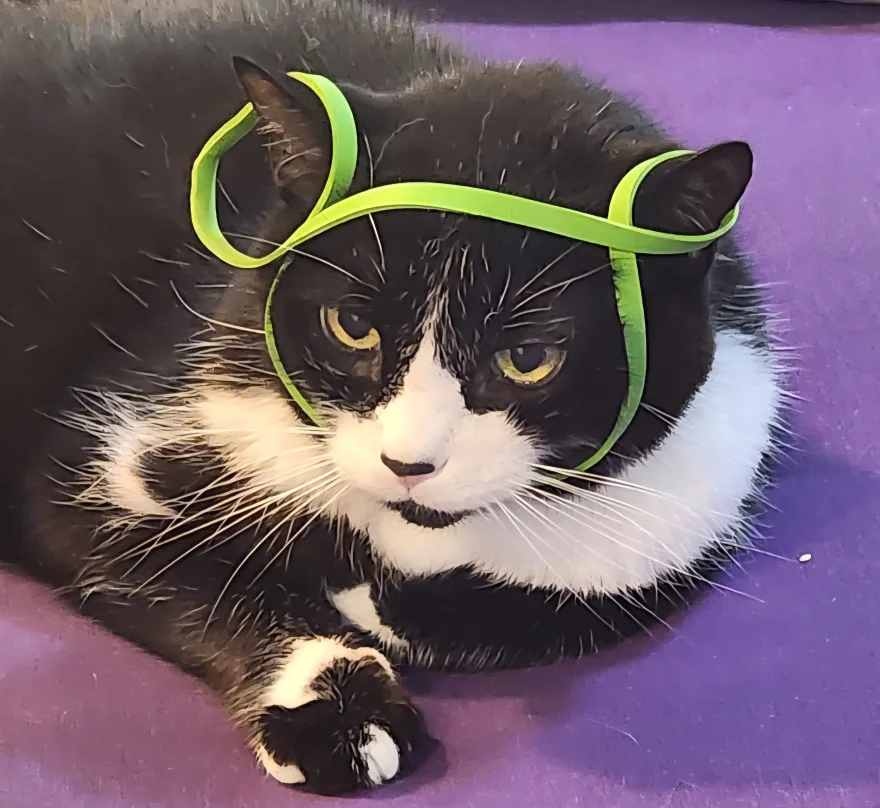
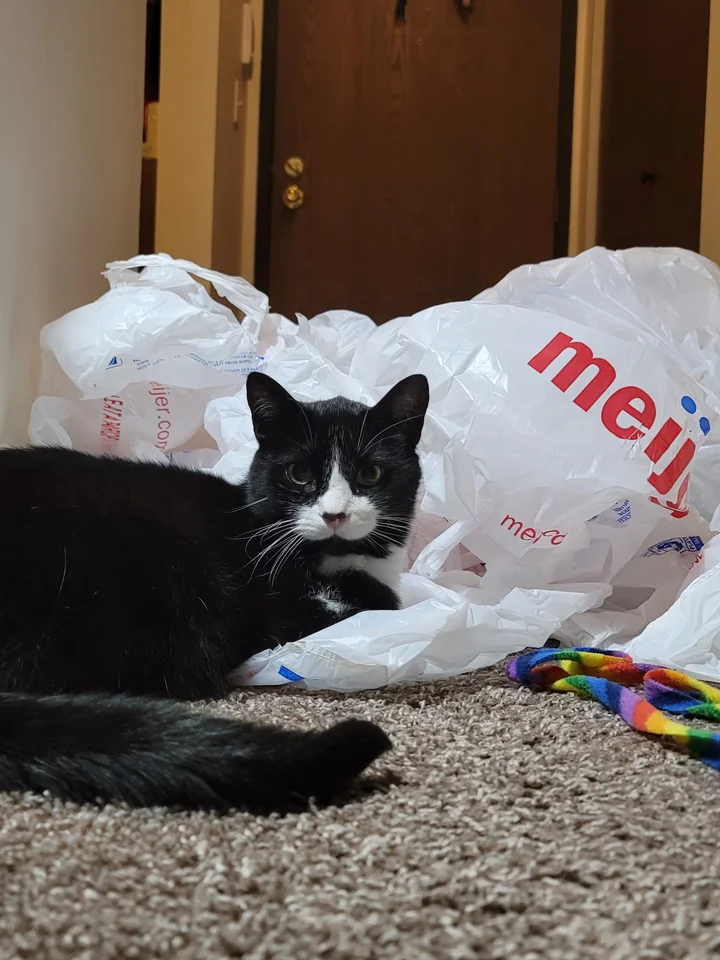
Home, in this story, was never a given. It was found once, at twelve — and rebuilt more than once since. Through the rebuilding years of the last decade and a half, one presence has stayed constant: Splash, Christopher's tuxedo cat — sixteen years old now, green-eyed, and the one Christopher calls his grounding force. Listeners already know him: he appears by name across the catalog, and he's the one photographed in the guitar case in the bio. He isn't a mascot and this isn't a memorial. He's a living member of the household, still on duty.
Three songs come from before Christopher had any idea he would write songs. They are the earliest memories he can hold clearly enough to build on, and they happened in this order.
Christopher was three years old. It was summer, and his grandfather drove a large van — sliding door, three rows of seats, an aisle running along one side. The trip was ordinary: his grandfather and his biological mother up front, Christopher in back. He had been assigned one of the back seats and argued his way into the rear bench instead, for a reason he kept to himself: he hated wearing his seatbelt, and in the way back nobody could see him take it off. The van got moving, and the belt came off.
Alone in the back, he could hear the adults talking and laughing up front, too far away to make out, and he wanted to be part of it. He stood and started down the aisle toward them.
The van took a curve. He lost his balance, caught the handle of the sliding door, and the door opened. He went out with it.
His head struck the curb directly, and he rolled. He was unconscious for only a few seconds. When he got up, the van was down the road with its taillights showing. At three, he didn't know taillights meant it was slowing; what he understood was that the van was still moving and nobody had noticed he was gone.
The van came back in reverse and stopped, and his grandfather was out of the driver's seat and running. He lifted Christopher off the road, and the first thing Christopher told him was that he had to get his shoes — sneakers that flashed red light with every step, the favorite thing he owned, lost somewhere between the door and the curb. The answer was a single furious profanity about the shoes, at full volume.
His grandfather set him in his mother's lap in the passenger seat. She was screaming and crying, and it was her fear — more than anything that had happened on the road — that finally frightened him, so he started crying too.
Then the daylight went dark. In the middle of the day, Christopher told his mother it was nighttime. She told him no — he could not sleep, he had to keep his eyes open — and she kept slapping his face to keep him awake while everyone he knew and loved passed in front of him, one after another.
The next thing he remembers is an operating table, being stitched back together.
He recovered. The swelling went down, his family treated him very gently for a long time afterward, and they still tell the story.
Christopher was six or seven, out in the woods on the outskirts of Whitehall with one of his cousins. It was the nineties; kids had free roam of the town, and the two of them went wherever they went.
They were walking a creek, talking about nothing in particular, when something moved above them. A branch was shaking. A squirrel up there was jumping branch to branch, and it missed one. It fell straight down through a tall oak without touching a single branch on the way.
It didn't land in the water. It landed at the edge, on the bank, hard, and then slid into the creek. It was moving wrong.
His cousin lifted it out first. The boys knew it was hurt and didn't know how to help it, so they took it to the only help they could think of — other squirrels. They knew where squirrels were: the big tree in the playground at their elementary school, not far off. They carried it there and set it down at the base of the trunk.
Then they waited and watched. One or two squirrels came about halfway down, looked, and went back up. Neither came close.
Eventually the boys went home, agreeing to come back and check. They did. The next day the squirrel was still there, still dead.
It survived the whole fall. It was the edge that got it.
This one is built on a memory Christopher can barely hold onto.
His biological father gave him a little voice-recorder toy shaped like a microphone — tiny, about the size of an adult finger. It held five or ten seconds, one recording at a time. It could be reset, but then the old recording was gone.
His father recorded himself on it, telling his son he loved him — forever and ever.
That was after the squirrel. And because it was after the squirrel, Christopher already knew something he hadn't known before: forever and ever isn't a thing that gets promised. It's a thing that gets tested. If it could happen to the squirrel, it could happen to anybody.
So he decided it wasn't going to happen to him. He was never going to die. He was very sure about that.
To the people listening → /thanks/
Where this started — thirteen days of named failure → /origin/
How the work actually gets made → /process/