Keweenaw Load
Christopher's own account of that stretch, in the form he had for it. It's about the day that almost broke him.
Before the phone and before the factory, Christopher's interest in systems led somewhere formal: an engineering school. This chapter does not end well, and it's told here anyway.
In the fall of 2007 he enrolled at Michigan Technological University to study geological engineering. The ambition was genuine — the same pull toward load, pressure, and structure that runs through everything on this site, pointed at a degree. He was there three years, Fall 2007 through Spring 2010.
His body was already failing him. The hip reconstructed at 12 was deteriorating toward the replacement it would eventually need, and the pain during those years was severe — on some days he could barely walk. He was trying to hold together a demanding technical program on a joint that was giving out.
Then the losses came, and Christopher is plain about their order. The center was the death of the dog he had had since childhood — the largest single loss of that period, and the one he names as the reason those years became unmanageable. The car he depended on being totaled was, in his words, "the final straw."
Under all of it, his grades collapsed, and after three years he was expelled without a degree. It was not a pivot, not a choice, not a redirection toward music. It was a real failure, and it stayed with him.
Through those three years he lived with his aunt and uncle, and they supported him while everything else came apart. He was not carrying it alone. It still ended the way it ended.
One more thing from those years belongs in this chapter, because it complicates the transcript. As Christopher remembers it, the engineering students were given a spatial visualization reasoning test, and when the results came back the lecturer made a point of one score before reading the rankings aloud: the highest in the entire college, across every section that had sat it. Then she read his name. He was not expecting it, and he did not make much of it at the time. He was also failing. There is no document; this is his memory of what was said in that room.
It was the second time a standardized test had said something about him that his circumstances did not. The first was in fifth grade, as a foster kid with no musical training, on a six-hour musical aptitude exam — the result that put a trumpet in his hands.
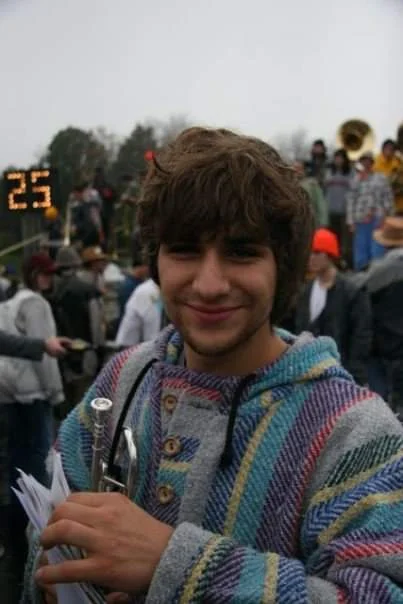
The other thing that held was the guitar. In those same years he found acoustic fingerstyle playing, and it became the one place both kinds of pain went quiet — the hip, and everything else. He found Andy McKee on YouTube when YouTube itself was still new; for a stretch, three of McKee's videos were concurrently the three most-watched on the platform, and "Drifting" — the one that broke out after users pushed it on Digg — was the one that reached him. Christopher's words for what that music does: it heals the soul.
After the worst of it, he decided he had to be able to play it. That was a long way to reach. "Drifting" is altered-tuning percussive fingerstyle, the guitar struck, tapped, and fretted at once, and he was coming from Green Day and Nirvana. He learned it anyway, and played it through. Then more of McKee's pieces, and then Antoine Dufour, Gareth Pearson, and Ewan Dobson. In the same years his grades were collapsing inside an engineering program, he taught himself a piece far past anything he had played before, and finished it.
None of what was happening had a name yet. The ADHD, the bipolar II disorder, and the depression that appear later in this story were all undiagnosed — he was coming apart with no explanation for why concentration, mood, and persistence kept failing. The later diagnoses give that period context. They do not give it a complete explanation, and they do not erase the outcome.
Two things survived the collapse: the technical curiosity and the guitar. Fifteen years later, the curiosity became FretNova, a mastering lab, and a catalog's verification systems — built without the degree. Chord shapes across a fretboard, waveforms across a spectrum: it feels to him like the same way of seeing, put to different use. It never went anywhere. It just had to wait for the tools. None of that cancels the transcript.
The collapse did not end on a clean date. The worst of what "Keweenaw Load" describes had eased, though what was left of it still hung around — and the stretch that followed holds a dare, a stage, a forest, and the hardest weeks of the era.
The guitar kept growing through all of it. His friends had watched the skill arrive almost too fast to track, and they loved hearing him play. One of them handed him a compliment with a hook buried in it: he was good, the friend said — but not good enough to play "Chinese Whispers," a Gareth Pearson fingerstyle piece hard enough that naming it was the whole argument. So he learned it. Completely: every voice of it, up to tempo, fluent. Not to teach the friend a lesson, though the lesson did get taught. He learned it because he had to know for himself whether the friend was right. He wasn't.
The piece got its night. At a club in downtown Muskegon, his uncle — the one "Redshift Memories" is written for, gone now — was the reason he went up at all; he talked him onto the stage. Christopher played "Chinese Whispers" and nailed it, and the room answered with more than it had given any of the bands and artists on before him. Then he packed up and left. The club's owner chased him outside to ask him to come back and play again. There is a song from that night — "Fret Sweat," sitting on an album that has not been released yet.
Housing in those years came in two chapters. The first was a rented room in a house shared with Chinese students. The language barrier was real, and there was not much socializing across it — but several times they cooked for each other, and the house itself ran well: quiet, workable, everyone holding up their end. Then he moved in with his close friends, most of them from Douglass Houghton Hall, the mixed dormitory where he had spent his freshman year — sharp, passionate, philosophical, engineering-minded people, the kind who will argue an idea late into the night for the pleasure of watching it hold or break. Their house stood on the road that climbs the Houghton hillside, and League of Legends had just come out, so the household was obsessed.
The street was Franklin Street. His grandfather's multi-unit house downstate — the brown house he grew up in — sat on a Franklin Street too, and this house was dark brown as well. It means nothing, and he knows it means nothing. He noticed it anyway. Noticing turns out to be most of what this part of the story is about.
One day in that stretch — classes still fresh in his mind, a season of long philosophical arguments banked behind him — he wandered off-trail into a large forested section of that hillside and slowed down until the detail took over. Under his shoe, and everywhere around it, were dozens of species of plant and insect he had never once seen in his life. The realization arrived from two directions in the same instant: how little of the world he actually knew, and a big-bang of self-awareness in the middle of knowing it — himself as a collection of atoms, some of them forged in stars, enormously privileged to be alive at that exact moment, hugely important and, at cosmic scale, small and forgettable, all at once. He stayed with it a long time. Years later he put the moment into a song almost exactly as it happened: I noticed I'm here — that's all that I know.
Then the federal loan money ran out. For a stretch he had no job and nothing left to buy food with, and this part gets told the way the rest of this page is told: plainly. There were runs of days without eating anything at all, and the longest was about a week. He hid it — when he went out, he let everyone believe he was going out to eat. He lost a lot of weight and got very thin, and underneath all of it the hip kept getting worse. What ended it was a friend, who got him a job alongside him at Taco Bell. That paycheck funded the rest of his stay, until he moved back downstate to his adoptive parents.
Back home, his mom took up the fight with him: the hip replacement he had been refused again and again. The earlier surgeons had turned him down over his age, and their caution never weighed what the joint was actually taking from him — days at Tech when he could not walk on it at all and missed class because of it, and other days when he was not absent but late, because the campus was big and he could only cross it slowly.
The refusals ended in an evaluation room at the University of Michigan, with the head of the orthopedics program. He examined the X-rays. He asked whether tying his shoes was difficult or painful — the answer was yes, and yes. He watched Christopher stand and take about three steps. Then he said, flatly, that he would do the surgery. He knew exactly why Christopher was there, and he knew about the refusals that had come before. Three steps were all he needed to see.
The fingerstyle thread runs to the present, and one of the players Christopher returned to most is Luca Stricagnoli, the Italian fingerstyle guitarist. Long before he ever saw him live, Christopher sent him a message on Instagram — a song recommendation, one guitarist to another, offered on the theory that they liked the same things, with no expectation of a reply. A reply came, from Stricagnoli himself: thanks for the recommendation, and he'd check it out.
When a live date came within reach, Christopher drove hundreds of miles and sat near the front. The performance held up to years of listening. Afterward, in the crowd filing out, a tap on the shoulder: Stricagnoli was a few steps behind him in the hallway. At the merchandise table Christopher was so locked on the man that he never registered the line that had formed; Stricagnoli called him up anyway, and they talked guitar for several minutes — warm, unhurried, and entirely down to earth. At the end, Stricagnoli told him that someone traveling a long distance to hear an artist play is among the highest compliments an artist can receive, and he thanked Christopher for the miles. The photo was Stricagnoli's suggestion.
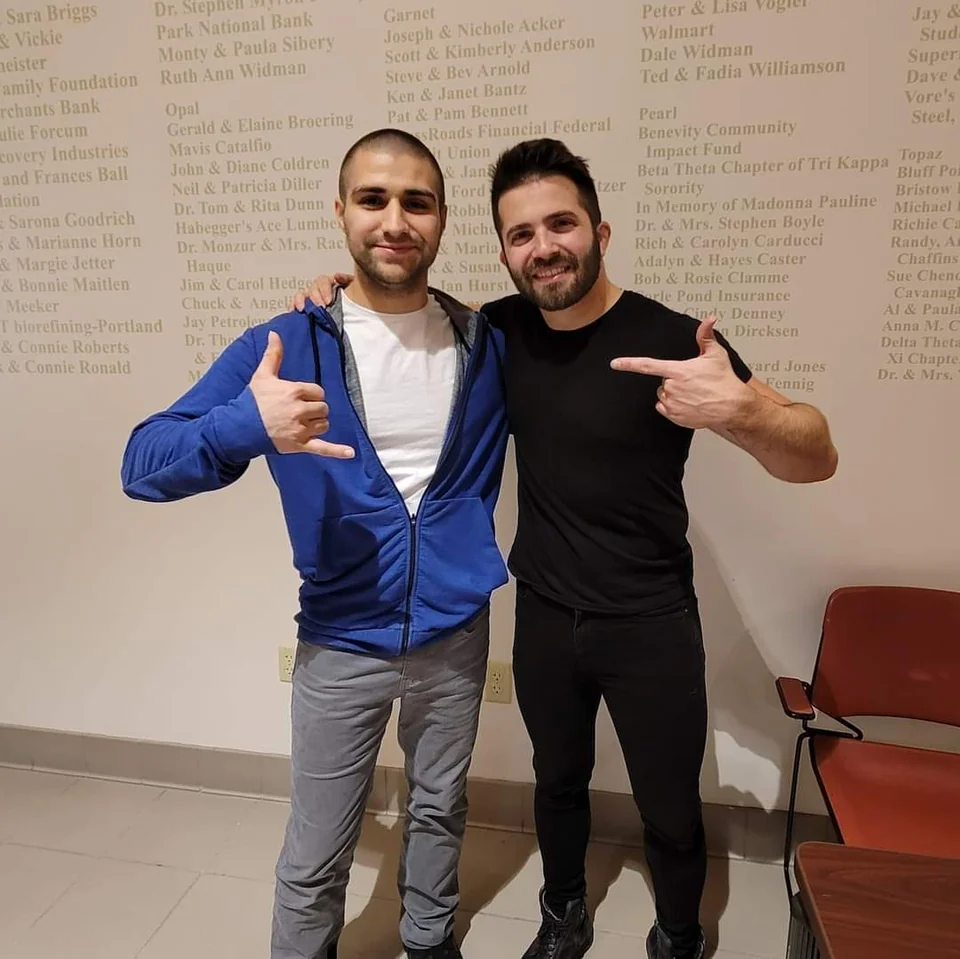
What stayed wasn't proximity to a name. It was the shape of the exchange — an artist meeting serious listening with serious gratitude. The thank-you page on this site is the same deal, run in the other direction: Christopher now keeps a page that thanks people for exactly what he once did. Drove miles for music.
Nine months before Christopher Jager wrote his first line of code, he reached the lowest point of his adult life.
Housing had become unstable. Work, money, relationships, and treatment had all begun to break down at once. A severe depressive episode became a suicidal crisis, and in September 2024 he sought emergency help and entered inpatient psychiatric care.
The details of that week belong to Christopher, not to the internet. What matters publicly is that he chose to stay, accepted help, and began rebuilding. Recovery was not a dramatic overnight transformation. It came through treatment, support, work, sleep, ordinary routines, and the slow return of interest in things that had once mattered.
What he lives with has names, and he has chosen to print them: bipolar II disorder, major depression, and predominantly inattentive ADHD. In plain terms, that means depressive episodes that can go deep and stay long, hypomanic stretches where energy runs high and sleep runs thin, and attention that drifts and scatters unless the work is structured to hold it. He has been writing about it across the catalog all along, for anyone listening closely. Naming it here is deliberate — and so is this: the conditions did not write the songs. Hypomania is not a work ethic, depression is not depth, and a 150-song catalog is not a symptom. It is managed — with ongoing treatment and regular checkups with his psychiatrist — by a person who builds things.
The ADHD is the oldest thread. It was undiagnosed during the Michigan Tech collapse — the diagnosis came afterward — and once it had a name, longstanding treatment helped him function for years.
After the 2024 crisis, that treatment was paused out of clinical caution. The caution was reasonable; the cost was real. Untreated, the symptoms caused a genuine decline in day-to-day functioning, including serious work consequences.
Treatment was restored carefully and under close monitoring, and the order of events matters: the restoration came first — then the steadier focus, then a new job going well, then the first programming. It's also fair to say plainly what a careful reader of this site may have noticed: the checklists, written handoffs, frozen specs, and strict file discipline that show up everywhere here also work as attention infrastructure. Not every system was designed as an accommodation, and none of them made the art. They are how a person with his particular attention keeps complicated work recoverable — a practice lived daily, learned the hard way.
By June 2025, he was working a new factory job and functioning well enough to begin experimenting with a program on his phone. On June 24, with no coding background, no computer, and no technical team, he opened the first conversation in what became FretNova. The next thirteen days were mostly failure: broken files, repeated restarts, thousands of lines that did not work, and forty-three project threads documenting every wrong turn. He kept the failures and finished the system.
The work that followed should not be framed as illness transformed into genius. Mental illness did not create the catalog, and extreme productivity is not proof that the battle is over. A more honest connection runs through the story: as stability returned, Christopher regained the ability to direct his attention toward a future. Building systems gave that future structure.
The program became a catalog. The catalog became albums, releases, verification pipelines, visual work, and a larger creative architecture. The same person who had recently struggled to imagine continuing began preserving every version, measuring every claim, protecting every original, and constructing work designed to survive repeated pressure.
And the battle is ongoing — some stretches are still harder than others, and sleep still puts up a fight some weeks. So the care is ongoing too, by choice. To be plain about it, because it's the part of this chapter that matters most: Christopher sought treatment, stayed with it, and continues it today — including regular checkups with his psychiatrist — as scheduled and non-negotiable as a factory shift. The work is real. The progress is real. Productivity is not the same thing as wellness, and this page will never pretend otherwise.
The thirteen days that came next, on the record → /origin/
To the people listening → /thanks/
Where this started — thirteen days of named failure → /origin/
How the work actually gets made → /process/