No Applause Built This
The inventory above says nobody was watching, which meant nobody would have noticed if he quit. The song is that condition stated plainly — no team chat, no shared threads… no applause built this.
No coding skills, no computer, no human technical help — one phone and a refusal to stop.
In plain language. This page is the before picture. In June 2025, Christopher had never written a program, owned no computer, and had no one to ask for help — just a phone and the hours around factory shifts. He spent thirteen days trying to build a tool for guitarists and failing over and over, and he kept the records of those failures instead of deleting them. The conversation titles and leftover files below are those records, shown exactly as they were written. They matter because the careful, rule-driven way he works now was learned here, one failure at a time. Nothing on this page has been polished after the fact. That is the point.
The other pages on this site describe a disciplined multi-AI operating system — bounded roles, output contracts, independent verification. This page describes where that system came from. Not from a classroom, a bootcamp, a mentor, or a career in software. From nothing. The first document is the machine. This one is the person who built it — before he knew how.
An honest inventory of what was actually available on day one.
In June 2025, Christopher Jager worked a factory job in Muskegon, Michigan. He had never written a program. Not a small one, not a broken one — none. He did not own a desktop computer or a laptop. There was no development environment, no second monitor, no mechanical keyboard, no quiet office. There was a Samsung Galaxy S22 Ultra — a phone already years past its release — and the hours around full-time factory shifts.
There was also no human expert to ask. No programmer friends, no online cohort, no course with a curriculum and a finish line. Nobody was watching, which meant nobody would have noticed if he quit. What he had instead was a picture in his head — a tool for guitarists that composed real music from real theory — and three things no one can install: vision, curiosity, and the drive to complete what he started.
Everything documented in the Skills Profile — the operating model, the prompt architecture, the verification pipelines — was acquired, not inherited. The record of that acquisition survives. It is not flattering. That is exactly why it is worth publishing.
The AI conversation log, June 24 – July 6, 2025 — titles preserved exactly as written, misspellings included.
Most origin stories are reconstructed after success and sanded smooth. This one doesn't need to be reconstructed, because every step was a conversation with an AI assistant — and every conversation has a title and a date. Read in order, the titles tell the whole story by themselves: what he believed, where it collapsed, and the exact day his thinking changed.
| 2025 | Project threads, as recorded | What was actually happening |
|---|---|---|
| Jun 24 | Infinite Song Generator · Infinite Guitar Song Generator With … (twice) · Ultimate Guitar Generator | Day one. The names are enormous. The knowledge is zero. |
| Jun 25 | Not Working · Notworking2 · Fix It · Fix Syntax ERRORS · Alignment · Audio For Android Users · Starting Over | Seven threads in one day. Two of them are named after the same failure. The last one is named Starting Over. |
| Jun 26 | Program Enchancements · Enhanced Display And Audio · Infinite Guitar Song Generator | Back at it. "Enchancements" is spelled wrong. The work continues anyway. |
| Jun 27–28 | Improve Main Program · Advanced Modern GUI That Runs Smoothly · New MODULARIZED Program | First appearance of an architectural word: modularized. Something is being learned. |
| Jun 29 | UPGRADES TO INFINITE GUITAR CH… · Guitar Chord Progression Generator · AI-Enhanced … · INTELLIGENT GUITAR PROGRESSION … | The project finds its true shape — not infinite songs, but chord progressions done right. |
| Jun 30 | Improving Program · Expanded Chord Database · Infinite Guitar Song Generator · Infinite Guitar Chord Progression Ge… · Frankenstein · Program · Main Program Won't Run | A conversation named Frankenstein: stitched-together code, barely alive. By nightfall the main program won't run. |
| Jul 1 | Debugging My Program · Program · Buggy Program · Chord Database Module (twice) · Updating Chord Enums Module · Update, Rework, And Enchance Main … | The vocabulary changes: debugging, module, enums. Failure is being taken apart into parts with names. |
| Jul 2 | Unworking Program · Guitar Chord Master | One last collapse — and one last grand title. |
| Jul 2–3 | FretNova | The project gets its real name — before the turn, not after it. |
| Jul 3 | Program Design And Creating Prompts | The turning point. For the first time, the conversation is not about the code. It is about how to think. |
| Jul 4 | FretNova 2.0 – Professional Guitar Chord … | A second version, within a day of the turn, with the word professional in the title. |
| Jul 6 | FretNova 3.0 · FretNova ∞ · FretNova ∞ HELP | A written specification: architecture, research phases, testing standards, accuracy checklists. The chaos has become a method. |
Forty-three project threads in thirteen days. On June 25 alone — day two — there are seven, and their names are a diary of collapse: Not Working, Notworking2, Fix It, Fix Syntax ERRORS, and finally Starting Over. A person with options quits on a day like that. A person with a vision starts over and comes back the next morning.
Three files that were never deleted.
From that first stretch, three source files survive in the original FretNova project space. Their names were chosen by a beginner describing his own work with brutal accuracy:
Twelve thousand four hundred six lines of not-good-enough — broken, dumb, and incomplete, by the author's own labels — preserved instead of deleted. That instinct matters more than it looks. Keeping the failed versions is the first primitive form of the discipline the Skills Profile documents in full: protect the record, measure against a baseline, never pretend the earlier state didn't happen. The verification culture started as a folder of embarrassing files he refused to throw away.
The names inside the log carry the same honesty. A conversation called Frankenstein is a beginner admitting his program is stitched together from parts he doesn't fully understand. Program Enchancements — misspelled — is a person typing fast on a phone at the end of a factory shift, more interested in progress than polish. None of it was written for an audience. All of it is evidence.
The day the question changed.
For nine days, every conversation title is about the code: fix it, debug it, improve it, make it work. Then, on July 3, a conversation appears with a different kind of name: Program Design And Creating Prompts. It is the first title in the log that is not about a program at all. It is about how to think — how to design software before writing it, and how to direct an AI with precision instead of pleading with it.
That is the hinge on which everything else turns. The name had already arrived — FretNova was created in the days just before it — but the thing it named was still the old chaos. The day after the turn came FretNova 2.0, with the word "professional" in its title. Two days later, FretNova 3.0 opened with something the June conversations could never have produced: a full written specification — modular architecture, research-before-implementation phases, testing standards, accuracy checklists, and a rule that every module be verified against professional sources.
Nobody taught him that. The failures did. Every principle in that specification is a scar with a date on it: modularity, because the monolith named Frankenstein collapsed; research first, because guessing produced Notworking2; verification, because "it runs" had already proven meaningless. The disciplined operating model in the Skills Profile is not a methodology he adopted — it is thirteen days of pain, formalized.
The same person, one year later — measured, not remembered.
The through-line from those thirteen days runs directly to everything the other pages describe. The beginner who named a file Working_dumb_code went on to write roughly 40,000 lines of Python on a touchscreen; to ship FretNova as a live web application at fretnova.com with thousands of chord voicings machine-verified against ergonomic rules, and an internal audit record available on request; to build a phone-based mastering laboratory that holds his music to professional loudness and true-peak standards; and to write, produce and master a 150-song, ten-album catalog, 91 tracks of it released so far — all in the hours around the same factory job, on the same phone. And the loop closes: a good handful of the catalog's songs are built on chord progressions FretNova itself generated — the first of them back when the engine was still terminal-only.
The order matters, too. FretNova came first. Its first working version — terminal-only, in Pydroid 3 — existed months before a single song was produced. The music production began with “Electric Motion,” the first finished song, completed December 4, 2025 — tool before craft — and the catalog that followed took roughly seven months, closing with the 150th song, “Last Mile,” completed July 3, 2026. Not a year.
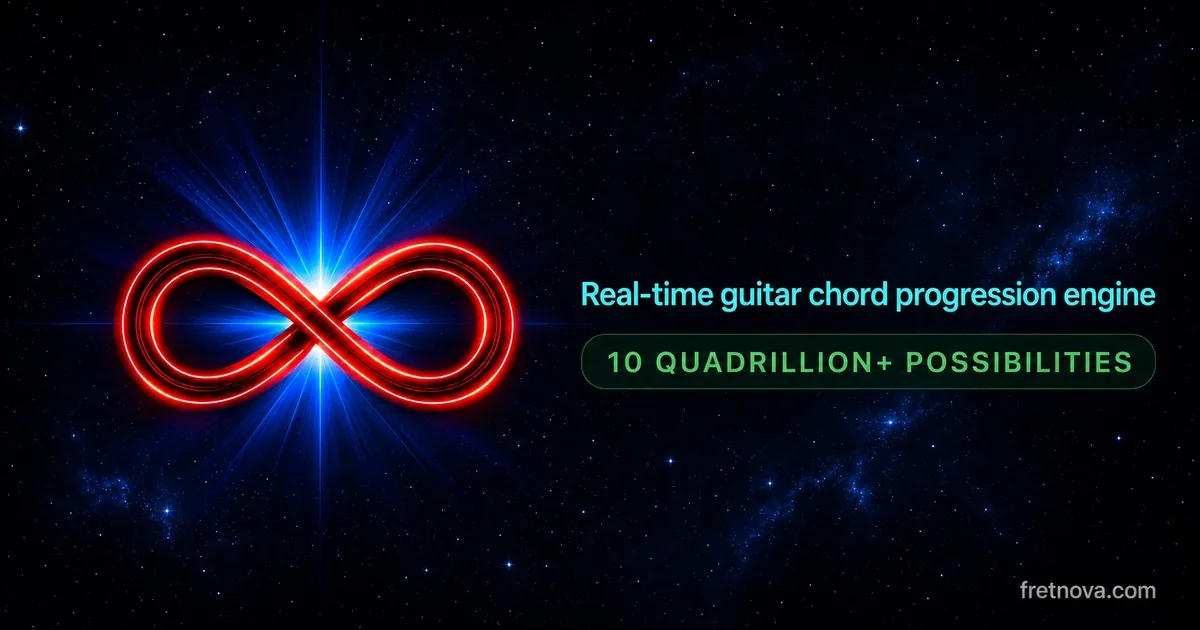
The live web application at fretnova.com — still carrying the ∞ the project took in July 2025, four months before a single song was produced.
The resources never changed. No studio appeared, no development team was hired, no funding arrived, no computer was purchased. The only variable that moved was skill — and skill moved because he refused to stop while it was still zero.
Read the pages together and the order matters. The process page answers "how does he work?" This page answers the harder question underneath it: "who decides to work that way?" Someone who found out firsthand, with no safety net and no witnesses, what happens when you don't.
The same project list, checked again in August 2026 — titles as recorded.
The log that recorded the collapse kept recording. Two days after the 3.0 specification, the project outgrew version numbers and took a symbol instead: ∞. And the titles keep telling the truth about what changed.
| When | Projects, as recorded | What was actually happening |
|---|---|---|
| Jul 6–8, 2025 | FretNova ∞ · FretNova ∞ HELP · FretNova ∞ · FretNova ∞ – V1.0 · # FretNova ∞ Project Creation Information · FretNova ∞ v2.0 · FretNova ∞ · FretNova ∞ (Rebooted) | The infinity era begins. Versions get numbers, creation information gets written down before building — and asking for help gets its own project instead of a scream. |
| Aug 15, 2025 | AI RISK ANALYSIS PROGRAM | The person who lost nine days to unverified AI output is now building a program to analyze AI risk. The scars are becoming tools. |
| Jul 22–27, 2026 | Christopher's Catalog Of Songs · Time-stamped Audio & Lyric Syncing · FretNova (Released) | One year on: the catalog is its own project, lyrics are synced to the audio by timestamp — and FretNova's title now contains the word Released. |
| Aug 2026 | Professional Audio Analysis & Correction · Remastering My Songs · Dirt Crown Music Video | The current working set, edited within days of this page going live. The mastering lab, the catalog, and the first music video — all still running from the same list that once held Not Working. |
This is what the work looks like from the inside: FretNova running in a terminal on the phone it was built on. The interface, the layout, and the colour scheme are Christopher's own design.
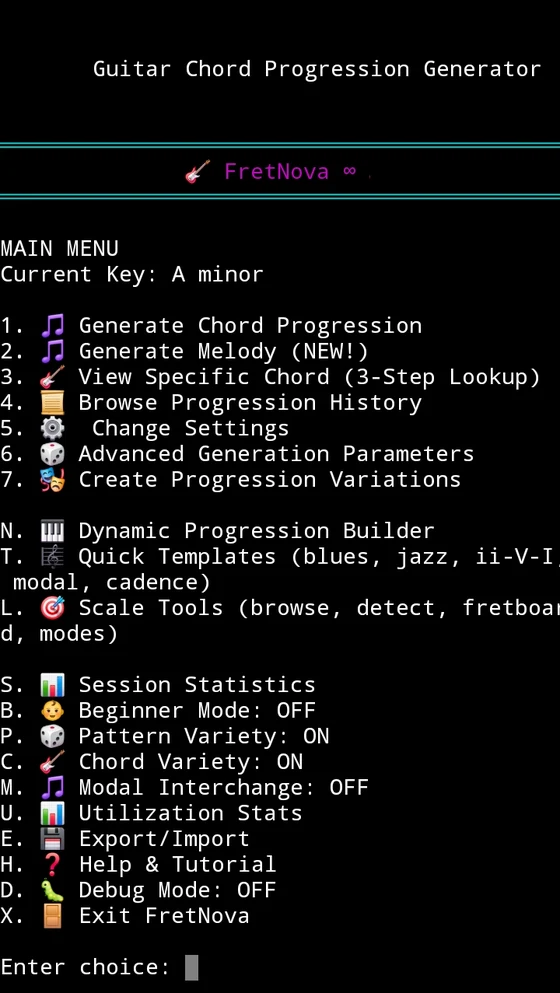
Progression and melody generation, a three-step chord lookup, scale tools, modal interchange, utilization stats — reached by single keystrokes, because typing on a phone is expensive.
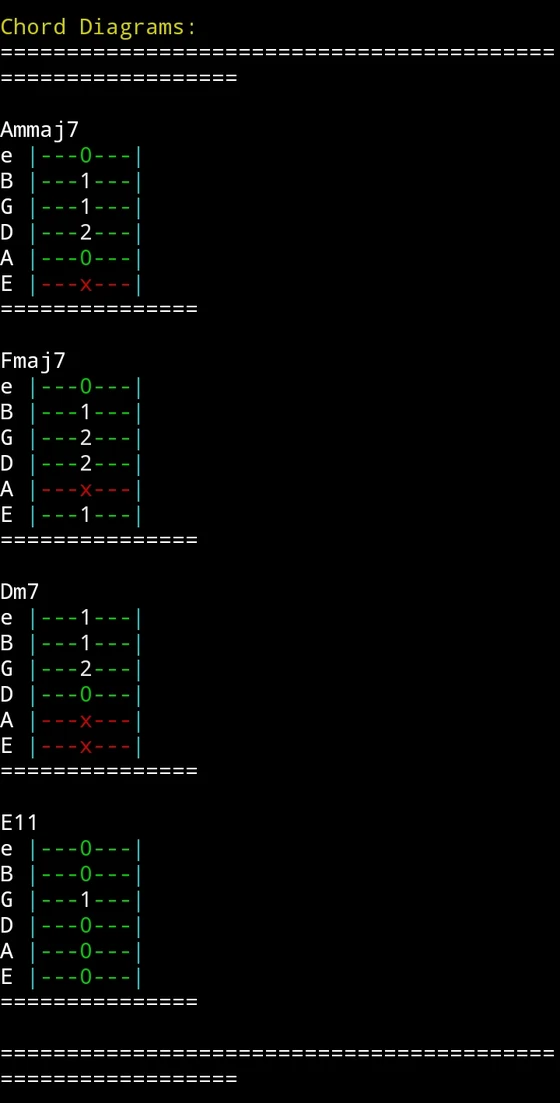
Green for every string you play, red for every one you don't — so the shape reads before you parse a single fret number. Both images open FretNova.com.
Nothing was renamed and nothing was deleted. Notworking2 and FretNova (Released) sit in the same list, thirteen months apart, under the same account, typed on the same phone.
One thing did change in August 2026: after the 150th song was finished, the S22 Ultra — slow by then, and holding more than 400 GB of a 512 GB drive — handed off to a Samsung Galaxy S26 Ultra, bought for him by his biological mother, who saw what the work needed while every spare dollar was going into the project. Every song in the catalog was made on the old phone; the first project the new one ran was building this website. The S22 stays in service as a physical backup of the whole archive.