Christopher JagerJagerNote Records · Muskegon, Michigan · August 2026
How theCatalog Works
Not a playlist. One work.
Most catalogs are piles of songs. This one is built like a novel.
The 150 songs form a deliberate eight-act arc — from The Invitation through The Break, The Grind and The System, to The Mirror — with 31 designated peak songs and 279 mapped lyrical connections between tracks — titles that reappear in other songs' verses, every use adjudicated as intentional. Motifs of steel, signal, memory and glow evolve act by act, and questions asked early are answered eighty songs later; those further layers are tracked separately from the published count. The connections aren't vibes; they're extracted from the full lyric corpus and adjudicated line by line.
Acts8a beginning, a break, a rebuild, a mirror
Total words86,796a novel's worth of lyrics — 8,363 unique
Mapped connections279title callbacks, adjudicated line by line — 472 occurrences
Catalog peaks31designated summit songs across the arc
What a connection is
A connection is one song reaching into another: a title callback — one song's title appearing inside another song's lyrics — counted once per song pair, with every use adjudicated as intentional. Two further layers run alongside the published count and are tracked separately: motif clusters — a recurring image, steel, signal, memory, glow, carried across tracks — and thematic links — a question asked in one song and answered in another. All 279 connections are extracted from the full lyric corpus and adjudicated line by line across all 150 songs, released and unreleased alike.
Reach — how many different songs one track connects to.
Weight — how many times those connections occur. A song can name twenty others once each, or name three others twenty times. Both are counted, and they mean different things.
Title callbacks — a sample
A sample of the title-callback layer only. Arrows run from the song doing the quoting to the song being quoted. Thickness shows how often.
The connections, audible
Algorithmic Drift
The mapped connections demonstrated instead of described: this song is built almost entirely out of other songs' titles, pulled into new verses. Checkable line by line.
Songs even hold structural jobs: doorway songs built as entry points for new listeners, hub songs that anchor the whole network, emotional anchors where the catalog breathes slowest. It's discography as architecture — designed to reward the listener who stays.
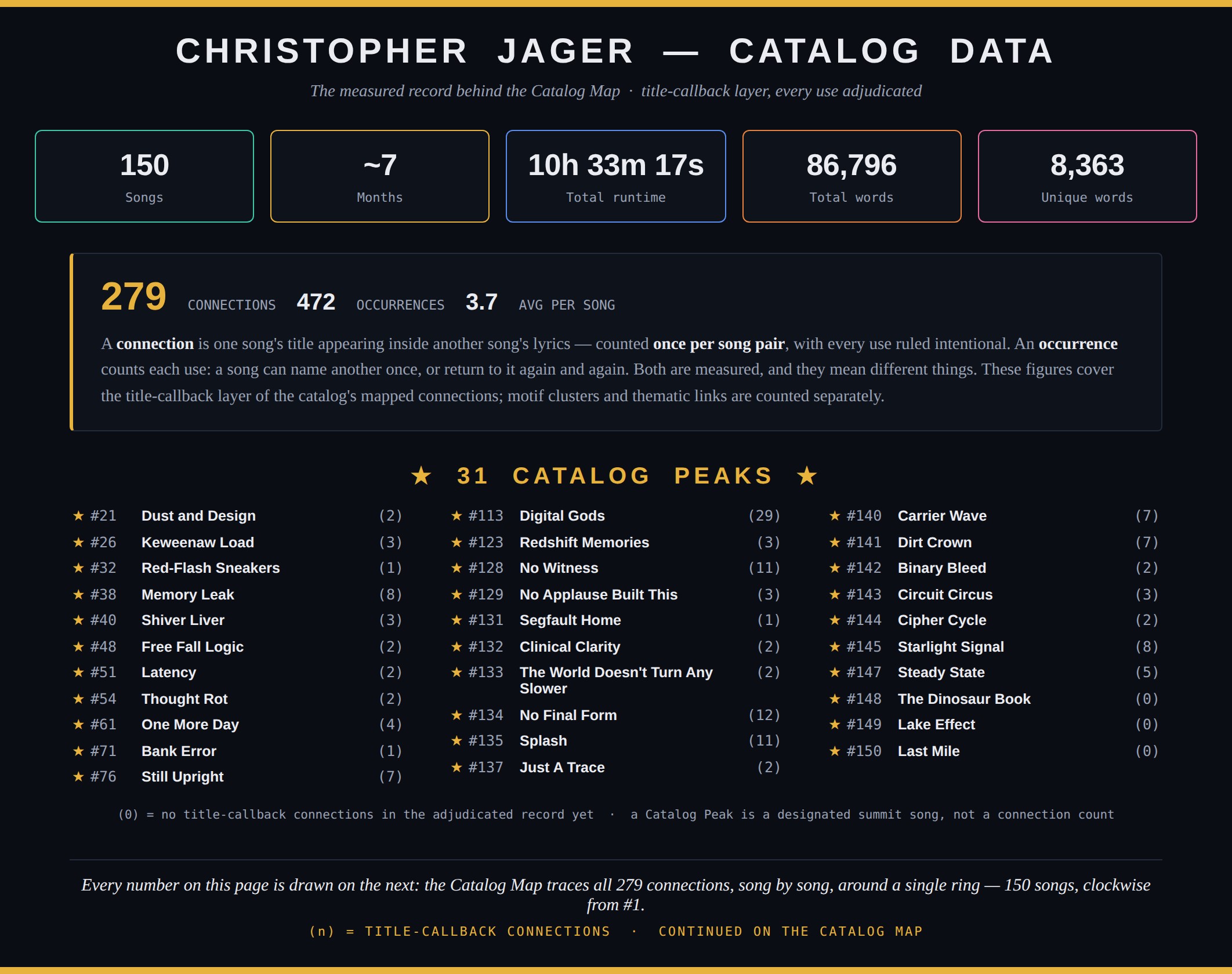
Catalog Data
The measured record behind the map — every figure the ring draws.
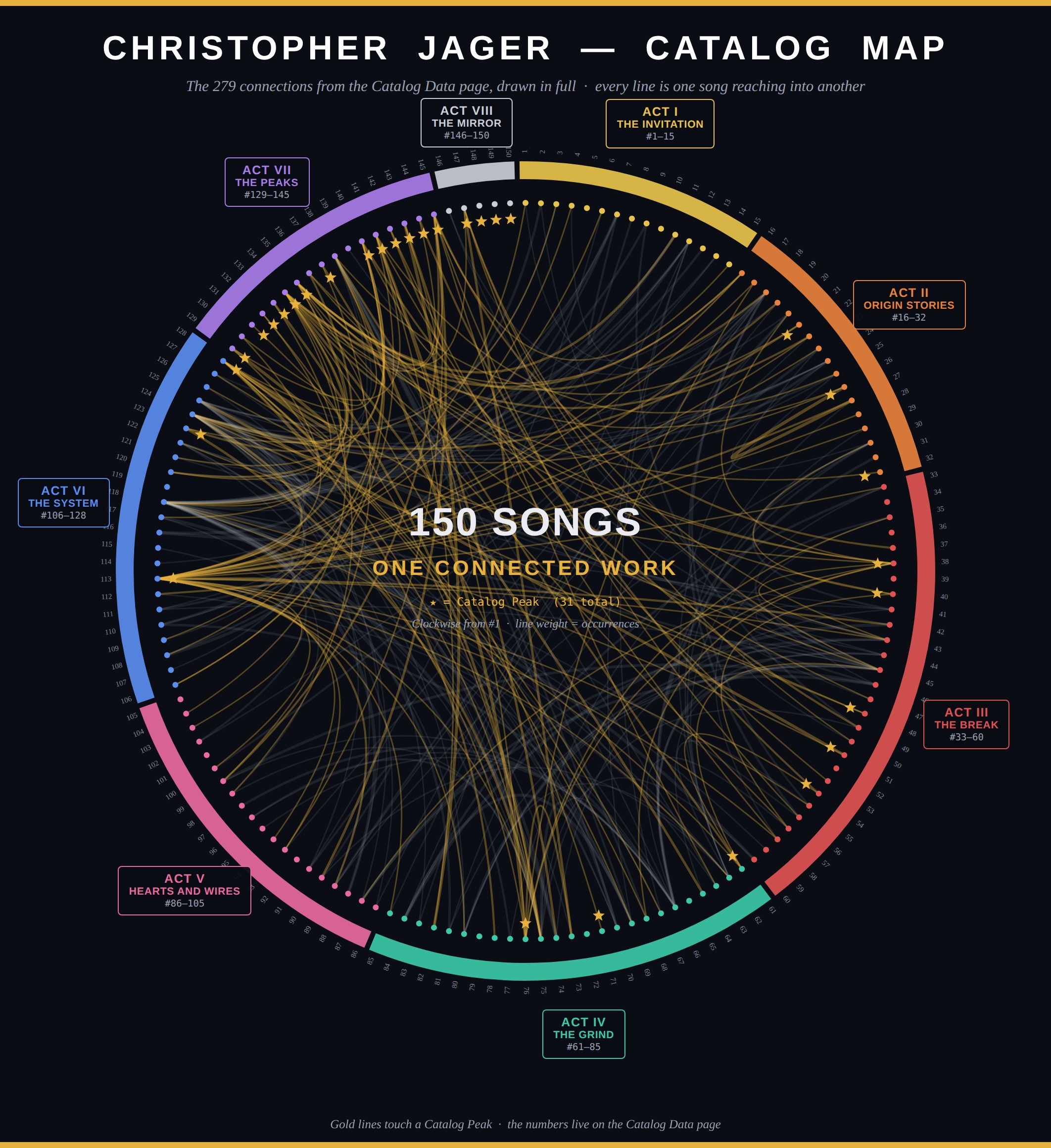
Catalog Map
The Catalog Data page, drawn: the full 150-song connection ring, with 31 Catalog Peaks marked.
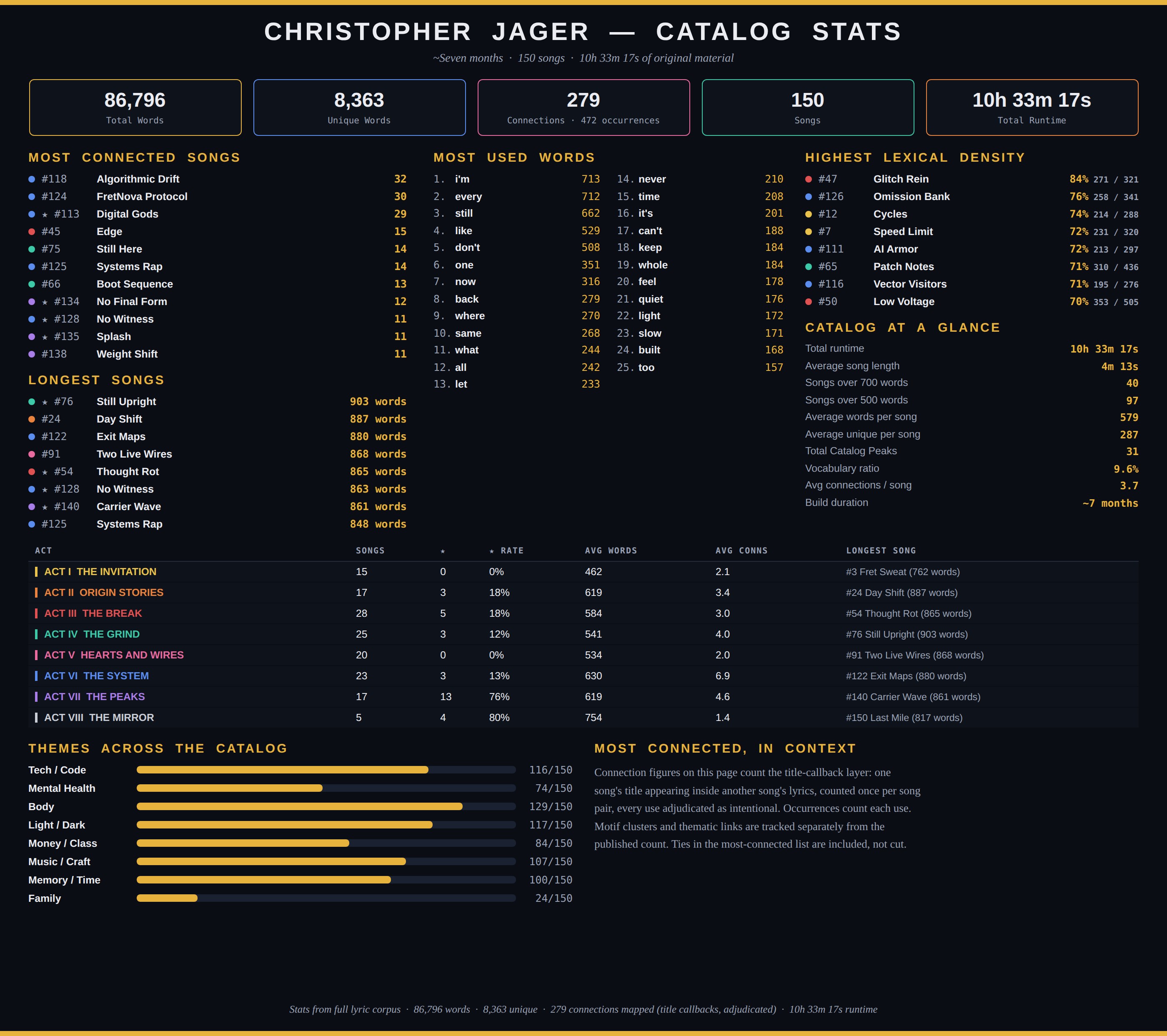
Catalog Stats
Corpus statistics — 86,796 words, 8,363 unique, 279 connections.
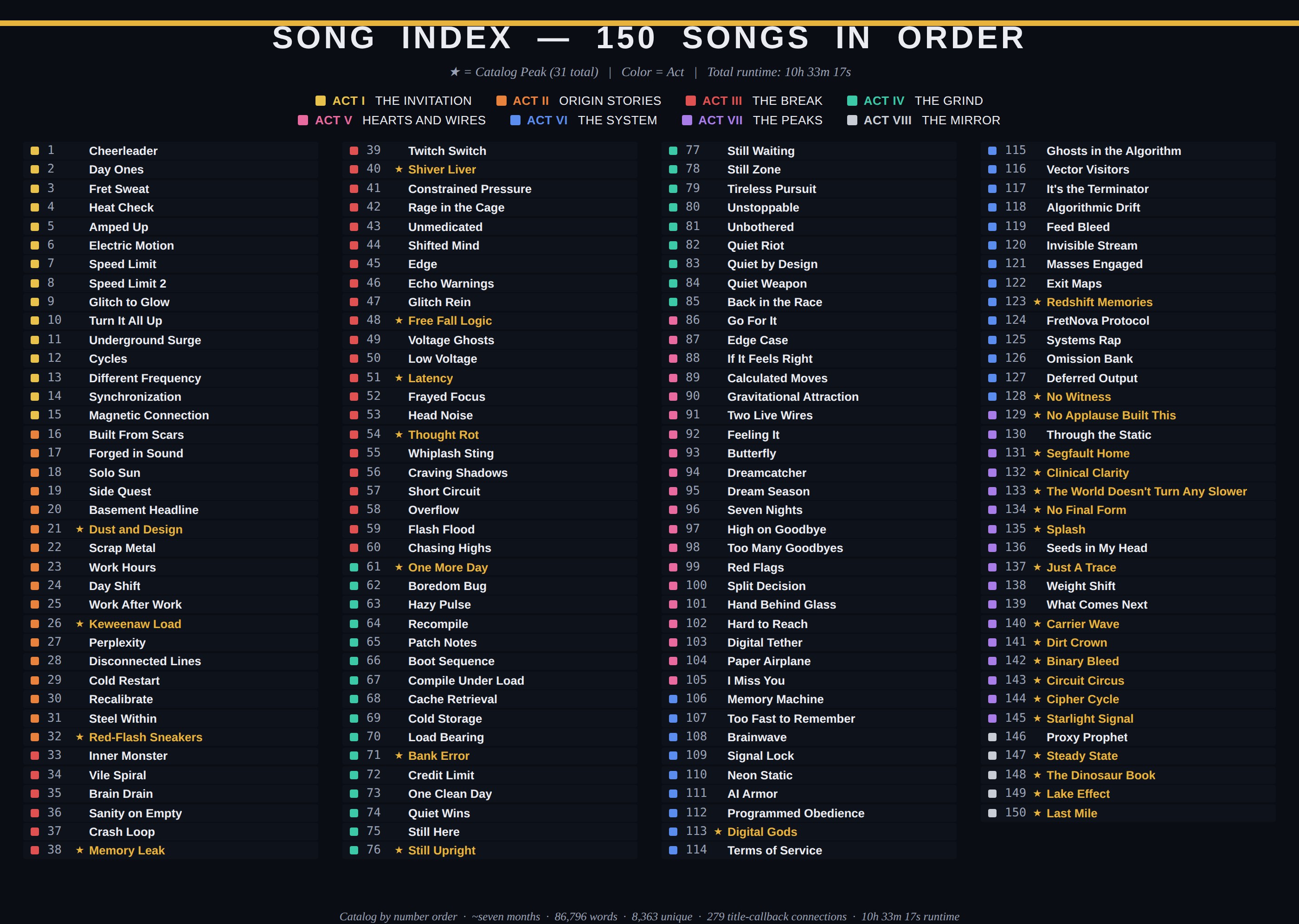
Song Index
All 150 songs in catalog order, grouped across the eight acts.
Systems Rap
Systems Rap is infrastructure-aware hip-hop that observes a system from within its operation. The speaker exists inside, participates in, or is acted upon by the system while exposing its rules, incentives, feedback loops, dependencies, and consequences through lyric, metaphor, performance, and musical structure.
The canonical definition — the five-question test, the intensity scale, the twelve lyrical requirements, and the measured record — lives at christopherjager.com/systems-rap.
Its governing principle is form as meaning: a Systems Rap track does not merely describe systems through its lyrics. Its structure, sequencing, callbacks, escalation, and relationship to the wider catalog make the song itself operate like a system.
It is not just fast rap. It has to work as music, writing, concept, performance, and system architecture at the same time. What qualifies:
Dense internal rhyme and technical phrasing
Systems, code, pressure, platform, work, and algorithmic metaphors
Emotional stakes underneath the technical language
Songs connected to broader catalog architecture
Hooks that keep the song accessible even when verses are dense
Structural escalation instead of random complexity
Two examples
The track that opened the lane, and the one that proves the principle.
Systems Rap Manifesto
Digital Gods
Catalog router / mission statement. The last song written for Unmedicated, the first album — and the first Systems Rap track made. It functions as an indexed map of the catalog, assigning songs and recurring ideas roles inside the larger architecture rather than merely naming or referencing them.
Form as meaning, demonstrated
Algorithmic Drift
Built almost entirely out of other songs' titles, pulled into new verses — the catalog network performed rather than described. Checkable line by line.